“ You can’t use up creativity. The more you use, the more you have.”
~ Maya Angelou
What do you think about altruism? Is it different than contribution? And how do generosity and creativity fit into the picture?
You heard it over and over when you were a kid, especially around the holidays. “It’s better to give them to receive!“ Yet Western culture is all about getting more, more, more.
If you’ve ever been to Burning Man or around the culture, you’ve probably heard the term ‘gift economy’ To me, however, the term is a bit of an oxymoron. The idea of ‘the economy’ doesn’t quite square with gift-giving and generosity.
Capitalism has given us this idea that everything should be monetized in one way or another. That generosity is a zero-sum game. But when you get locked into the mindset that every creative idea has to be able to scale and earn money, something essential is lost.
I enjoy reading the work of an Australian tech blogger named Joan Westenberg. They recently wrote a great essay about the sheer pleasure of making stuff — solving a problem that maybe just a few people have, and then giving it away.
They mention a book by Marcel Mauss called The Gift published in 1925, noting that “Mauss studied indigenous societies across the Pacific Northwest and Polynesia and found that gift-giving operated as a complete system with its own logic, its own power dynamics, its own hierarchies, its own concept of value. Gifts created social bonds. They established reciprocity. They built trust in ways that market transactions can’t.”
For Benedictine monks living in the sixth century, “Work was understood as a form of devotion, valuable in itself rather than as a means to accumulate wealth or status. The monks built in private, for people they could see and know, finding meaning in the craft itself.”
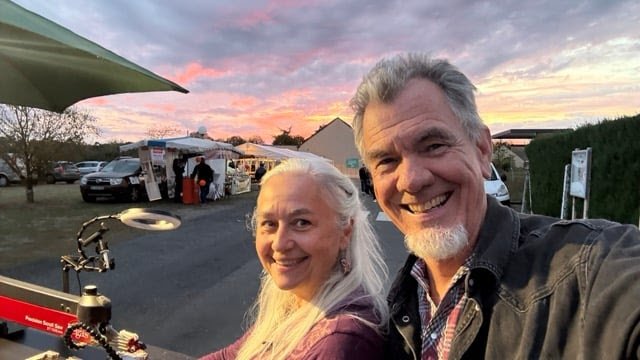
Which brings me to the Boules de Canton. Yesterday we visited a small makers market in the village of Chahaignes. Included in a local woodworkers display were some intricate fist-sized balls comprised of a series of concentric spheres, each free to rotate independently.
They seemed quite pricey for their size, until he started explaining to us the process of making them. Once we understood the number of hours that must’ve gone into each one, they seemed more than reasonable at over €100 each.
The history and lore of these artifacts is fascinating. He explained that if you were to visit a noble’s house in Canton back in the 1500’s and notice that they had one prominently on display, it generally meant that this person had done some great service and had been given this as a tribute in recognition.
So, in the early days, they weren’t something you could buy. To see one was to know you were in the present of a great contributor who had been honored for their altruism. The fact that untold hours of effort had been put into the crafting of the artifact only reinforced the value of their contribution.
Prestige in these scenarios has more to do with a person‘s ability to give than their propensity for making money. When we narrow our definition of value to strictly financial concerns, we lose sight of something important.
It’s fun to think about the things you could create that cannot be bought. Sometimes you have to try a few different paths before you find the right one for you. There’s more to life than commerce and consumption.
Once you are comfortable tapping into your flow, the question of scarcity dissolves into the field of abundance. Creativity is like the music in the great dance of life!
Sending you all the best, in the flow with you till next Monday!
Merci et à bientôt!
M+
ML #671
Mark Metz
Monday Love Movement Calendar